



 2025.12.09


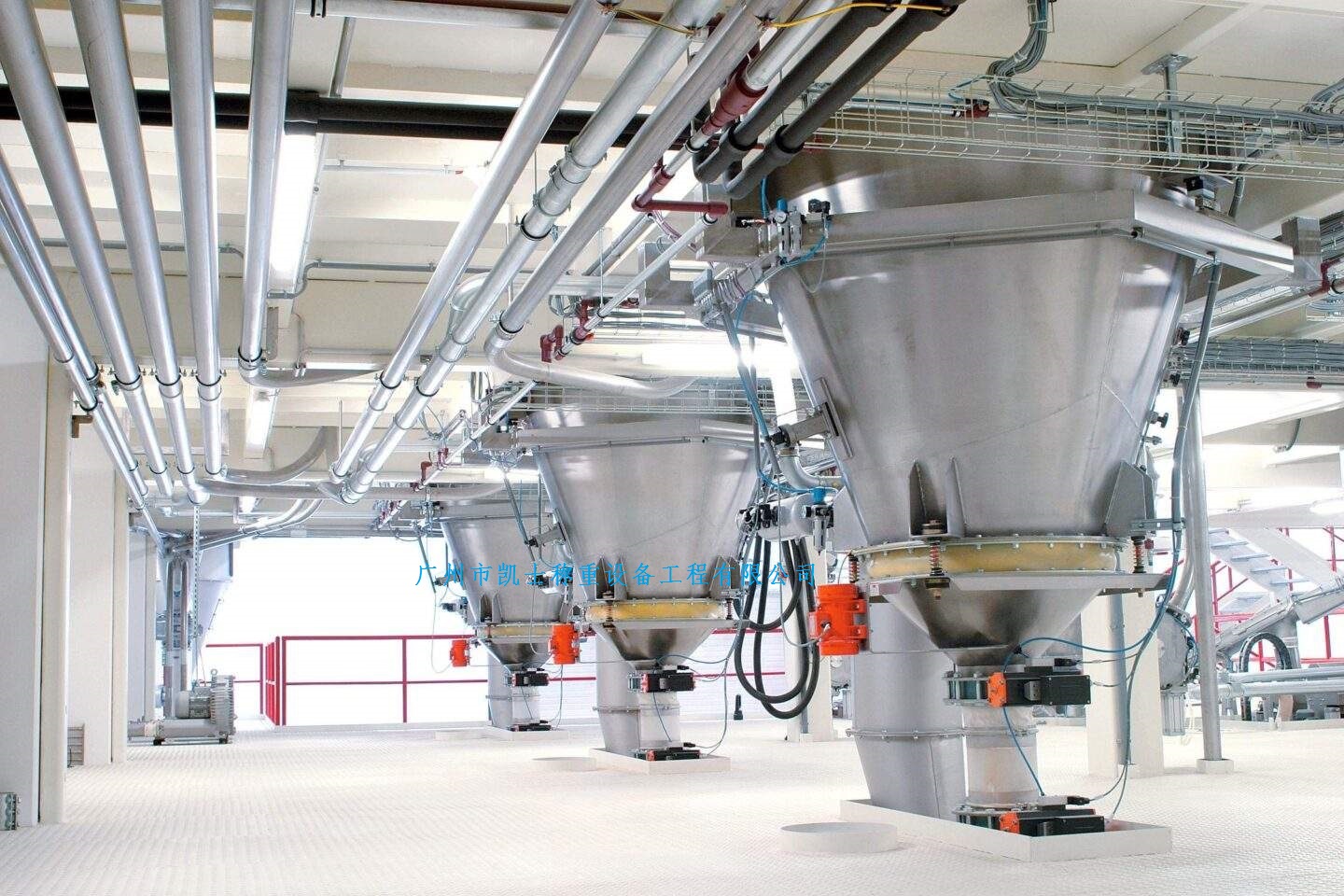
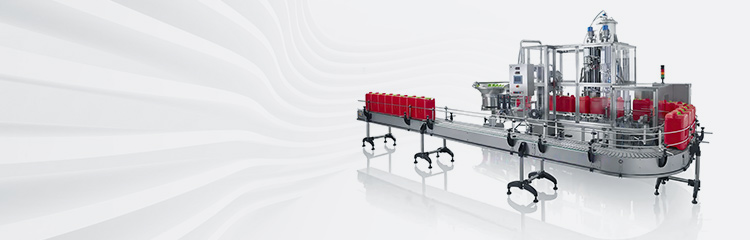
Summary:The spiral hopper scale adopts A double-spiral structure conveyor, generating a certain sealed and constant centrifugal force. Under the action of gravity, the weighing sensor converts the weighing signal into a voltage signal. After amplification, adjustment and processing by the transmitter, the data acquisition card performs A/D conversion, and the generated digital quantity enters the PLC system for processing. It can also feedback and adjust the coordinated actions of the motor, pusher and discharge valve.
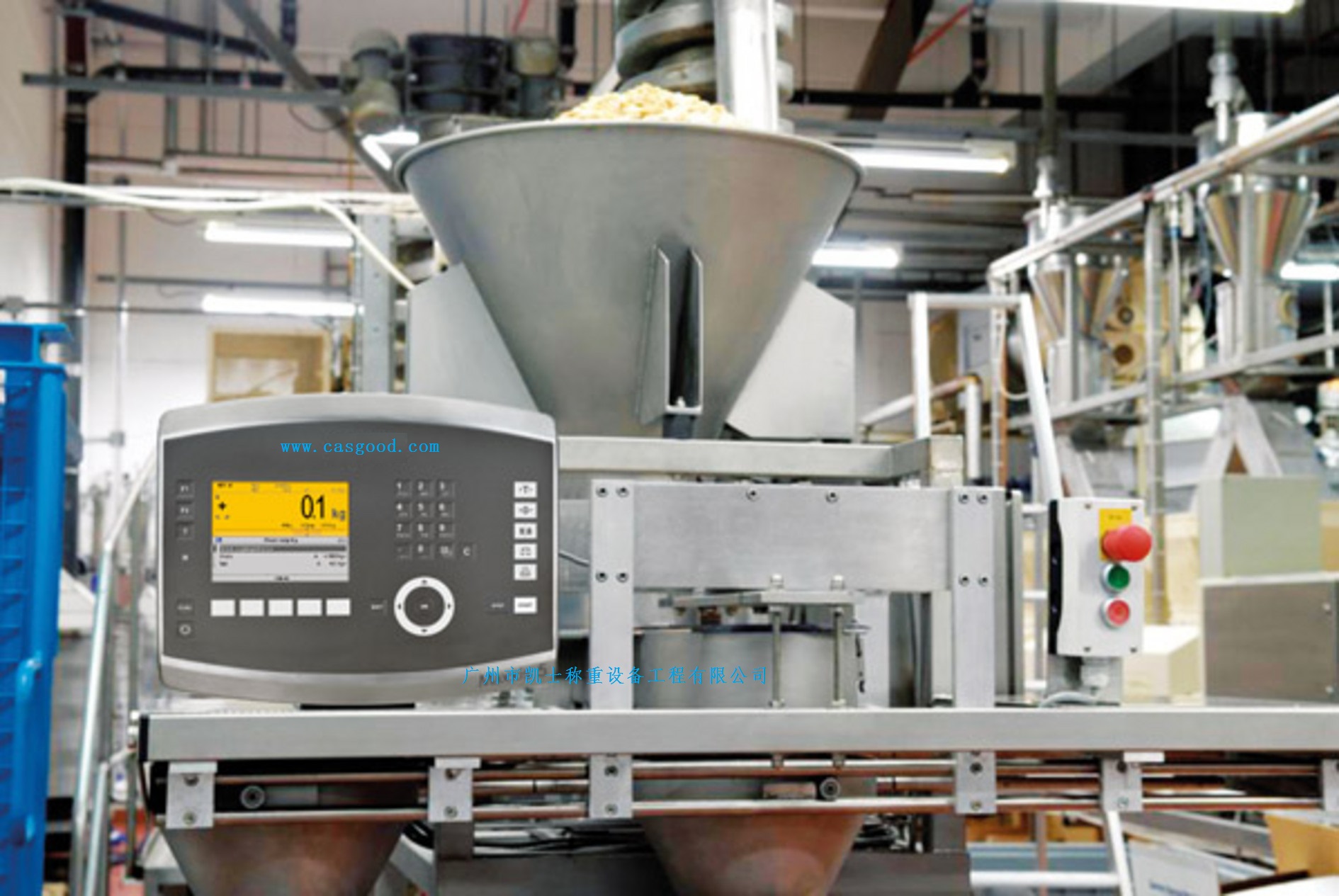
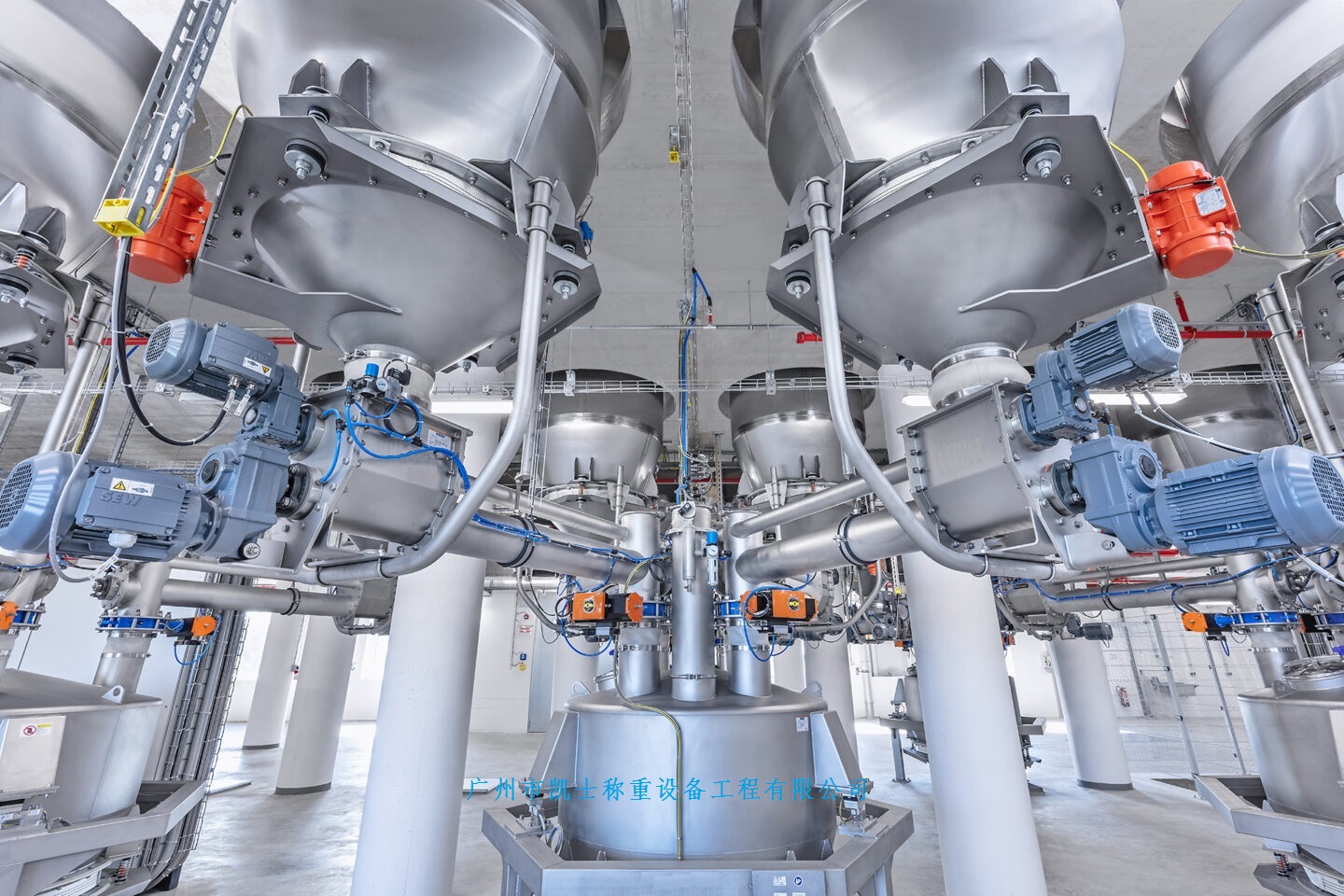
The screw hopper scale is a continuous weighing and feeding equipment, consisting of two major parts: the mechanical scale body (frame, hopper or pre-weighing hopper machine, transmission device, weighing module, discharge hood, screw machine, etc.) and the control system (controller, on-site control button box, AC frequency converter). It can automatically adjust the material flow rate by regulating the screw speed according to the set feeding rate, ensuring continuous material transportation at a constant feeding rate and automatically accumulating the total amount of transportation. Because it simultaneously has the functions of continuous material conveying, dynamic weighing and quantitative feeding control.
The signal output by the weighing module of the spiral hopper scale is processed by the analog signal processing unit (composed of signal amplification, filtering, voltage/current conversion and amplifier, power supply circuit for the weighing sensor, etc.), and then a 0-20mA current signal is sent to the load input interface of the weighing instrument. After being converted by the AD chip, it is sent to the PLC system. The rotational speed of the motor driven by the hopper scale is processed by the weighing module and the weighing instrument and then sent to the PLC system. The PLC system calculates and compensates the collected load signal and speed signal to obtain the actual instantaneous flow rate. After comparing this flow rate with the given flow rate, it undergoes preset adjustment operation and PID operation. Then, as needed, the D/A converter outputs one or more standard analog signals. These signal values are directly input into the control terminals of the frequency converter to change the rotational speed of the driving motor, enabling the actual feeding volume to track the flow quickly, accurately and stably.
Under the screw hopper scale, the gravity is sucked and discharged by the rotational motion of two meshing but non-contact screws. One end of the main transmission shaft of the screw rotor extends out of the motor body and is driven by the motor. The driving screw and the driven screw with different thread rotation directions are connected by synchronous gears. Through the close contact between the screw and the motor body, between the suction port and the discharge port of the motor, It will form multiple sealed Spaces with a certain volume. When the screw motor is in operation, the driven screw rotates together with the meshing driving screw through the synchronous gear. The pressure in the meshing space of the screw rotors on the suction cavity side gradually decreases as the sealed volume increases. Under the action of the pressure difference, gravity is sucked into the sealed meshing space. The sealed meshing volume gradually increases and forms a large oil suction chamber. Gravity then moves along the spiral in the secondary axial direction within the sealed chamber until it reaches the end of the discharge chamber. At this point, the volume of the closed space meshing with the spiral rotor at the end of the discharge chamber gradually decreases, and the pressure increases, expelling the gravity. As the screw continuously rotates and meshes in a cycle, the sealed space constantly travels at the suction end and continuously discharges gravity along the screw, achieving the purpose of conveying.
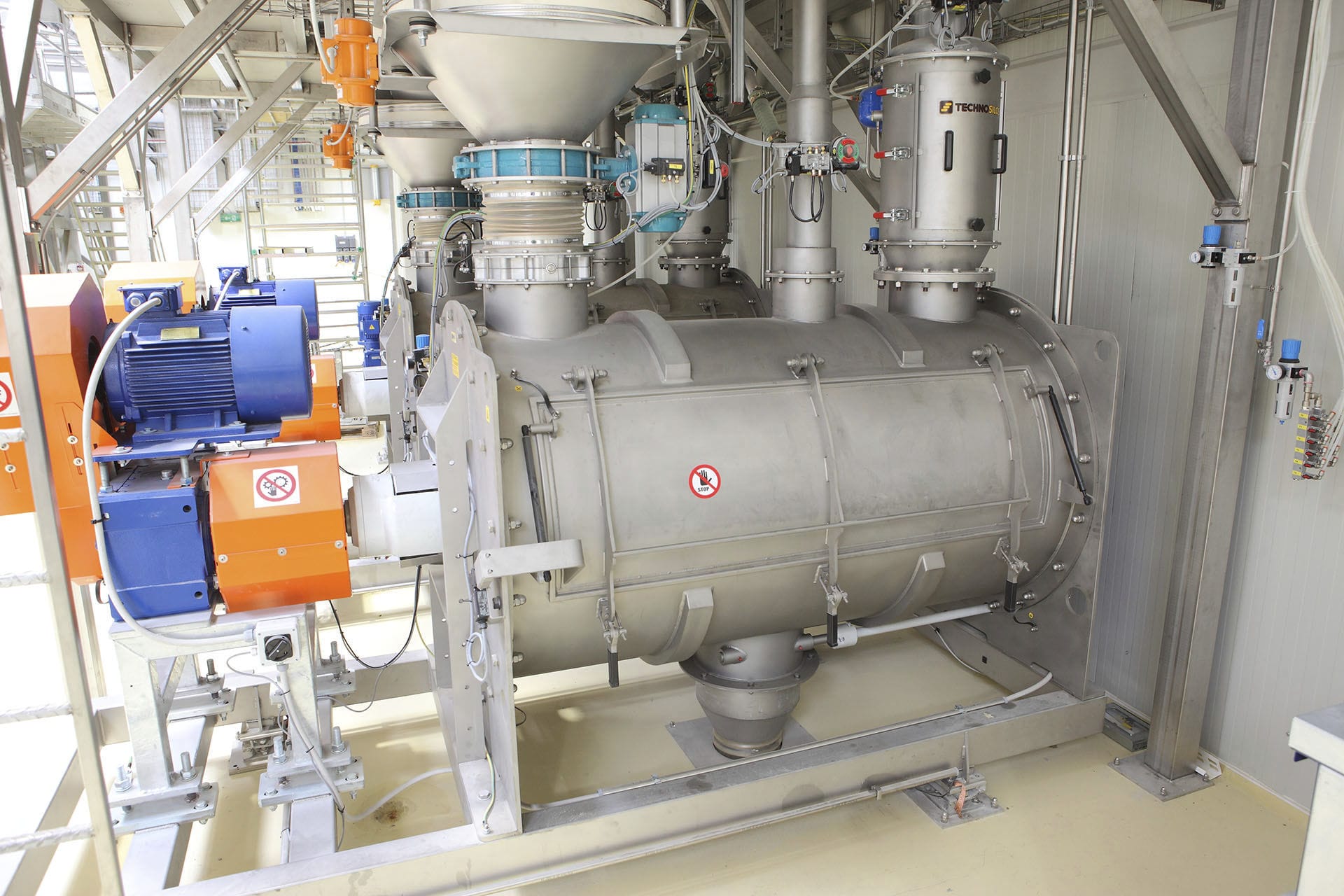
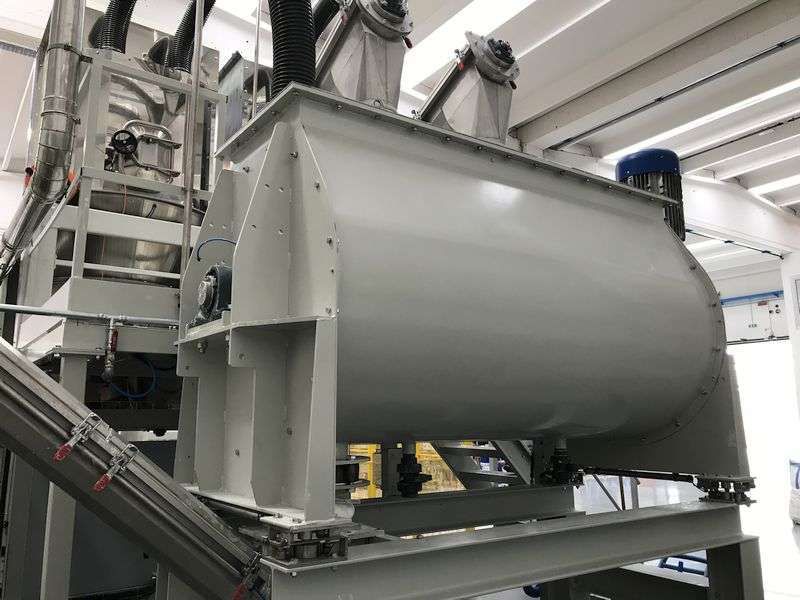
The weighing hopper machine adopts a double-screw structure conveyor. The double-screw structure is installed in an "8" -shaped body, which is composed of a stepping motor, a reducer and a spiral shaft with spiral blades. The rotation of the screw shaft causes the powdered material to undergo relative motion along the screw surface. The material, under the frictional force of the trough or the wall of the conveying pipe, does not rotate together with the screw blades, thereby pushing the material along the axial direction. As the screw rotates, the material inside the machine body is pushed forward and moves forward. Meanwhile, during this process, the material is compressed, creating a certain sealing effect inside the machine body. Subsequently, a certain constant centrifugal force for sealing is also generated. Under the action of gravity, the weighing sensor converts the weighing signal into a voltage signal, which is then amplified, adjusted and processed by the transmitter. The A/D conversion is carried out by the data acquisition card, and the generated digital quantity enters the PLC system for processing. It can also feedback and adjust the coordinated actions of the motor, pusher, and discharge valve.
The quantitative hopper scale accepts the start and stop signals from the DCS system to control the operation of the controller. After the controller starts running, the control signal sent out is transmitted to the frequency converter through the interface card to control the operation of the frequency converter. Set the manual and automatic conversion switch of the on-site button box to manual. In addition to accepting the start and stop signals from the on-site button box to control the start and stop of the frequency converter, the interface card also converts the resistance value of the potentiometer in the on-site button box into a current signal to control the operating frequency of the frequency converter. The weighing hopper machine composed of frequency converters receives the start signal sent by the PLC weighing module system. According to the set speed and acceleration values, it starts the screw conveyor. After reaching the maximum speed, it runs at a constant speed to generate a constant centrifugal force for feeding. During the quantitative process where the weight of the material reaches the set target weight, a weight control signal is issued in real time based on the weight. The frequency converter starts the screw conveyor, and the screw causes the weighing module to be subjected to force and start to operate. The material falls from the material preparation hopper into the hopper scale, and the weight of the hopper scale is measured in real time by the weighing module. The weighing module, based on the current weight of the material, Control the material preparation hopper to feed materials into the hopper scale in sequence at three speeds: fast, medium and slow. When the weight of the material is much less than the set target weight (generally less than 70%), feed the material quickly. When the weight of the material is between 70% and 90% of the target weight, feed at medium speed. When the weight of the material exceeds 90% of the target weight, feed slowly to ensure accuracy. When the material reaches the target weight, immediately stop feeding. Generally, there is an early shutdown drop quantity because there is still some weight of the material in the air and the actuator has a delay. At the end of the feeding section and when the deceleration point is reached, the weighing module system sends a signal to cut off the high-speed operation. The frequency converter reduces the maximum speed to the crawling speed at the set deceleration speed. During the deceleration operation process, The frequency converter can automatically calculate the distance from the deceleration point to the stable speed point of the formula and calculate the optimization curve. Thus, it can operate according to the optimization curve, reducing the low-speed crawling time to 0.3 seconds. After the first braking is completed, the frequency converter enters the low-speed stable operation stage of the formula. When the formula is completed, the frequency converter brakes and stops, and the entire feeding process is completed.
In order to keep the speed of the weighing hopper machine stable during the feeding process and the formula mixing process, and to maintain the constant magnetic and stress fields in the feeding and formula processes, a dual closed-loop regulator of current and speed is adopted to achieve precise speed control. The frequency converter itself is equipped with a current detection device, thus forming a current closed loop. Through a rotary encoder coaxially connected to the motor, two-phase pulses are generated and enter the frequency converter. While confirming the direction, a speed closed loop is formed by pulse counting. Two frequency converters are used. One adopts the main drive and uses dual closed-loop control of speed and current. Through the excellent speed regulation performance of the vector frequency converter, the entire system has a speed reference point. The other frequency converter adopts the secondary drive and uses current control. Its speed can well follow the speed changes of the main motor, thus keeping the speeds of the two motors synchronized and balancing the torque distribution. The PLC system accepts external speed setting signals, and the slave machine follows the torque and speed setting of the main drive through optical fibers. The load distribution function can be completed simply by setting the internal parameters of the frequency converter, without the need for a master-slave dual closed-loop control program in the upper computer PLC.